
Many learners begin memorizing Quran by repeating the sound of an ayah until it feels familiar. Repetition matters, but repetition alone can leave a fragile kind of memory: the tongue knows the line, while the mind has little to hold when the line slips.
Meaning-first memorization changes the order. Before the learner tries to keep the ayah, they ask: what does this ayah say, where does it sit in the surah, and what idea should I carry with me?
That is the center of the Al-Husen Method.
The problem with sound-only memorization
Sound-only memorization can work for a while, especially on short passages. The difficulty appears later:
- similar lines begin to blur together
- a forgotten word can break the whole sequence
- review becomes mechanical instead of reflective
- learners may finish a page without knowing what they are carrying
This is why many students can recite from the beginning but struggle when asked to start from the middle. The memory has one entrance. If that entrance is blocked, there is no second path in.
What meaning-first practice adds
When you begin with meaning, each ayah gets more than a sound pattern. It gets an idea.
- What is the main meaning of this ayah?
- Which word or phrase anchors that meaning?
- What comes before it?
- What comes after it?
- How does this ayah continue the movement of the surah?
That context gives recall more ways back. If the exact sound fades for a moment, the meaning can lead the learner back toward it.
How Al-Husen structures the practice
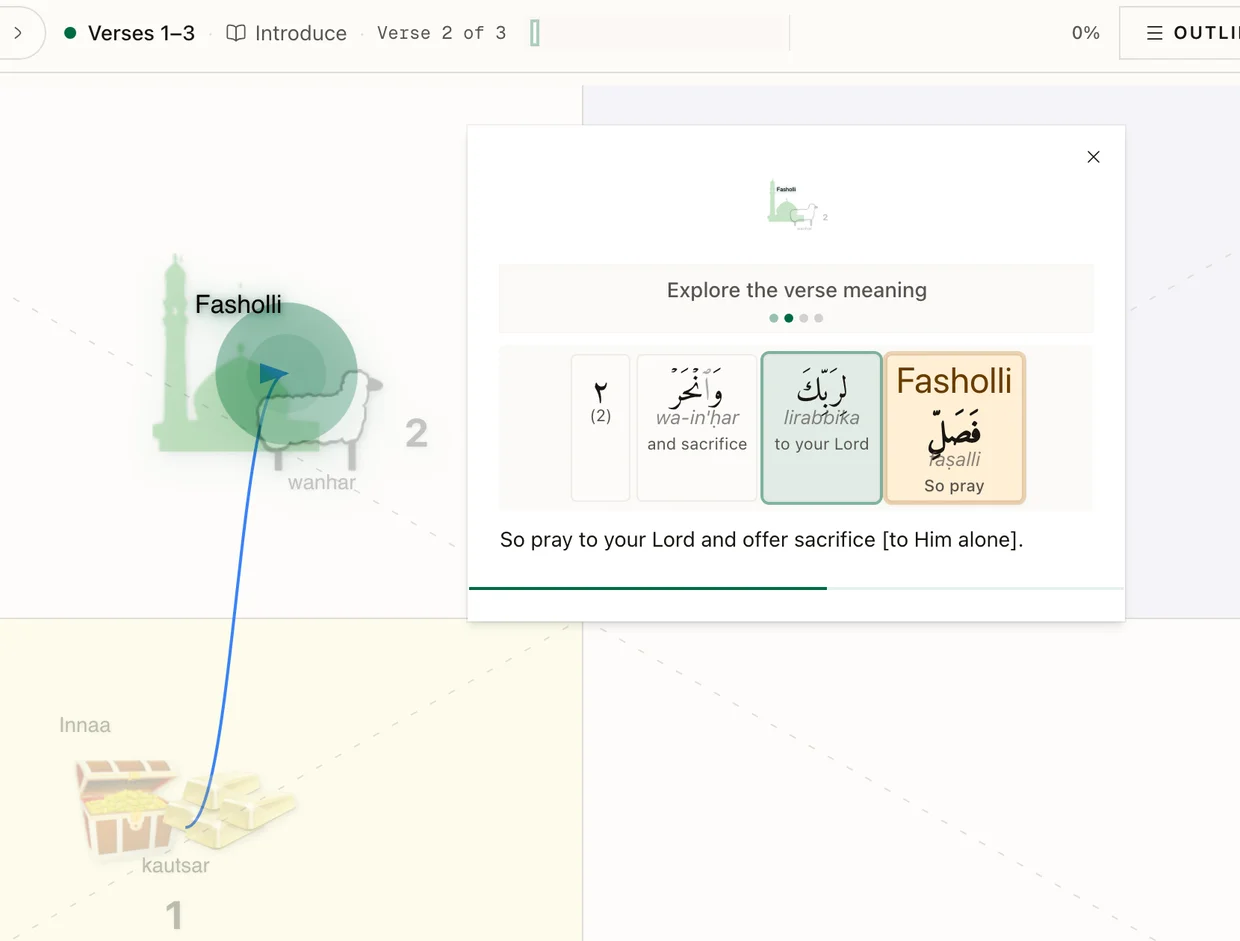
In Al-Husen, every ayah is treated as one learning unit. The learner does not separate translation, Mushaf text, audio, and review into different tools.
- Understand the ayah and its word-by-word meaning.
- Look at the correct Mushaf writing.
- Listen to a correct recitation.
- Connect the ayah to a visual stone on the surah map.
- Recite and review until the wording, meaning, and place stay together.
The goal is not to decorate memorization with pictures. The goal is to give every ayah a meaningful place in memory.
Where to start
If you are new, start small. Choose one short surah, or browse the public Surah memorization guides. If you prefer to think by Quran divisions, start from the Juz memorization guides.
One ayah a day is enough to begin. Read its meaning. Listen. Look. Place it. Recite it. Come back before it fades.